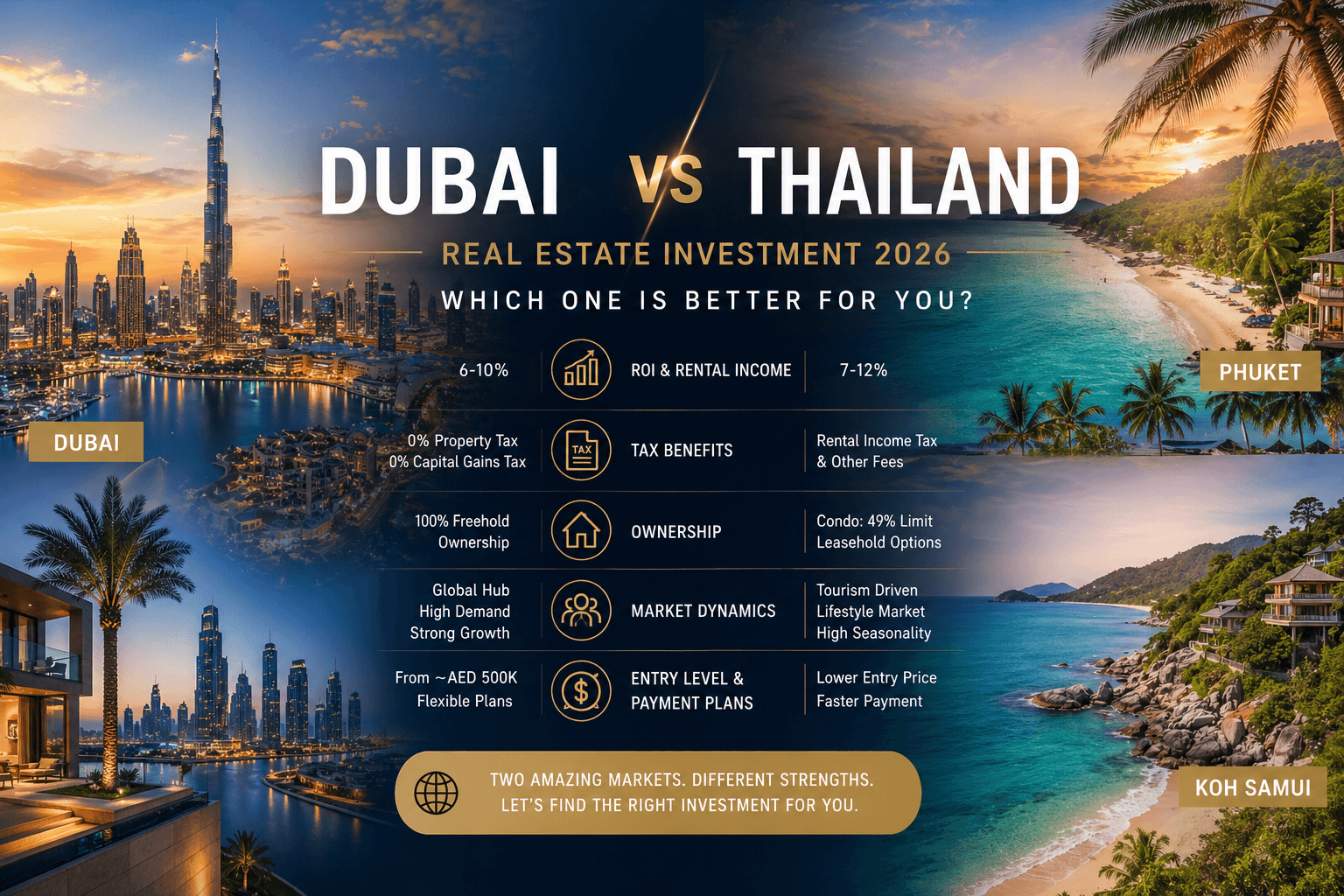
Dubai vs Thailand Real Estate Investment (2026): Phuket & Koh Samui Compared
Dubai or Thailand in 2026? Discover the key differences between investing in Dubai vs Phuket and Koh Samui – ROI, taxes, ownership, and long-term potential explained.
Dubai vs Thailand Real Estate Investment (2026): Which Destination Is the Better Choice for International Investors?
Introduction
International real estate has become one of the most attractive asset classes for investors seeking diversification, passive income, and long-term capital appreciation. Among the many destinations available today, Dubai and Thailandconsistently rank among the most popular choices for foreign buyers.
While both markets offer exciting opportunities, they appeal to different investment strategies. Dubai has built its reputation as a global financial and business hub with tax advantages, transparent regulations, and ambitious infrastructure projects. Thailand, particularly Phuket and Koh Samui, attracts investors looking for lifestyle properties, holiday homes, and strong tourism-driven rental income.
The question is simple: Which market offers the better investment opportunity in 2026?
The answer depends on your goals. Are you looking for stable long-term appreciation, predictable rental income, or maximum short-term returns? Do you prefer a fully regulated market with flexible payment plans, or are you willing to accept more complexity in exchange for lower entry prices?
This guide compares both destinations across the factors that matter most to investors.
Market Overview
Dubai
Dubai has transformed itself into one of the world’s leading real estate markets over the past two decades. Government-backed development, investor-friendly regulations, world-class infrastructure, and a rapidly growing population continue to fuel demand.
Major projects such as Dubai Islands, Palm Jebel Ali, Dubai South, and the expansion surrounding Al Maktoum International Airport are creating entirely new investment districts.
Unlike many global cities, Dubai continues to welcome foreign investment through freehold ownership, Golden Visa programs, and a tax-friendly environment.
The market attracts professionals, entrepreneurs, digital nomads, multinational companies, and high-net-worth individuals from around the world.
Thailand
Thailand has long been one of Asia’s most popular tourism destinations.
Phuket and Koh Samui continue to attract millions of visitors every year thanks to their beaches, tropical climate, luxury resorts, and relaxed lifestyle.
International buyers are often motivated by:
- Holiday homes
- Retirement properties
- Airbnb investments
- Lifestyle purchases
Unlike Dubai, Thailand’s property market is heavily connected to tourism, making occupancy rates more seasonal but potentially highly profitable during peak travel periods.
Return on Investment (ROI)
Rental yield is often the first metric investors consider.
Dubai
Typical gross rental yields range between 6% and 10%, depending on location and property type.
Some of the strongest-performing areas include:
- Dubai Islands
- Business Bay
- JVC
- Dubai South
- Downtown Dubai
Dubai benefits from demand generated by residents rather than tourists alone. Long-term rentals provide stable monthly income, while short-term rentals continue to grow thanks to business travel and international tourism.
Investors also benefit from relatively low vacancy rates in well-located developments.
Thailand
Phuket and Koh Samui can generate 7% to 12% gross returns, particularly for professionally managed holiday rentals.
However, these figures depend on several factors:
- Tourism levels
- Seasonal occupancy
- Property management quality
- Marketing
- Online booking platforms
During high season, occupancy can reach excellent levels. During quieter months, rental income may decline significantly.
For experienced investors, this creates opportunities. For passive investors seeking predictable income, it introduces additional risk.
Property Prices
One of the biggest differences between both markets is affordability.
Dubai
Entry-level investment apartments generally start around AED 500,000, while premium beachfront developments command significantly higher prices.
Off-plan developments remain particularly attractive because buyers can spread payments over several years instead of paying the full amount upfront.
This makes premium real estate accessible without requiring the entire investment immediately.
Thailand
Thailand generally offers lower purchase prices.
Buyers can find quality condominiums and villas at prices that are often below comparable properties in Dubai.
However, financing options for foreign buyers are more limited, meaning purchasers frequently need to provide a larger proportion of the purchase price themselves.
Lower entry prices make Thailand attractive for lifestyle buyers, but financing flexibility remains more limited.
Taxes and Investment Costs
Tax efficiency plays a major role in long-term investment performance.
Dubai
Dubai continues to be one of the world’s most tax-efficient real estate markets.
Foreign investors benefit from:
- No annual property tax
- No capital gains tax on property sales
- No tax on personal rental income
- No inheritance tax on real estate
The main acquisition cost is the one-time Dubai Land Department (DLD) transfer fee, currently 4% of the purchase price.
This transparent cost structure allows investors to accurately forecast long-term returns.
Thailand
Thailand has a more traditional tax framework.
Investors should consider:
- Rental income taxation
- Transfer fees
- Withholding tax
- Stamp duty in certain transactions
- Ongoing ownership expenses
While taxes remain reasonable by international standards, overall costs are generally higher than in Dubai.
Ownership Rules
Legal ownership is another major consideration.
Dubai
Dubai offers genuine freehold ownership to foreign investors in designated areas.
Buyers receive registered ownership rights protected by a highly regulated legal framework.
Developers must also comply with escrow regulations designed to protect off-plan buyers.
This level of transparency has significantly increased international investor confidence.
Thailand
Thailand operates under different ownership regulations.
Foreigners generally:
- Cannot directly own land
- Can own qualifying condominium units within legal limits
- Often purchase villas through leasehold structures
- Sometimes use company ownership depending on legal advice
The purchasing process is therefore more complex and should always involve qualified legal professionals.
Payment Plans
One area where Dubai clearly stands out is financing flexibility.
Many developers offer attractive payment structures including:
- 10–20% booking payments
- Construction-linked instalments
- Post-handover payment plans
These structures reduce the amount of capital required at the beginning of the investment.
Thailand typically requires faster payment schedules with fewer long-term financing options available for foreign buyers.
Rental Market Comparison
Dubai’s rental market is supported by multiple demand sources.
These include:
- Residents
- Corporate relocations
- Entrepreneurs
- Long-term expatriates
- Tourists
Demand is diversified, reducing dependence on a single sector.
Thailand relies much more heavily on international tourism.
A successful holiday rental property can outperform many traditional investments during strong travel periods.
However, tourism fluctuations directly influence occupancy rates.
Capital Appreciation
Long-term value growth remains an important objective.
Dubai
Government investment continues to reshape the city.
Projects such as:
- Dubai Islands
- Palm Jebel Ali
- Dubai South
- Metro expansion
- Al Maktoum International Airport
are expected to support future property values.
Population growth also continues to create long-term housing demand.
Thailand
Capital appreciation is generally strongest in established tourist destinations with limited land availability.
Beachfront locations remain particularly desirable due to natural scarcity.
However, price growth tends to be more moderate than Dubai’s fastest-growing districts.
Lifestyle Benefits
Investment decisions are rarely based purely on numbers.
Dubai offers
- International business environment
- Modern infrastructure
- Excellent healthcare
- High safety standards
- Global connectivity
- Luxury lifestyle
Thailand offers
- Tropical climate
- Beautiful beaches
- Relaxed pace of life
- Lower living costs
- Strong tourism appeal
- Excellent hospitality
For many investors, lifestyle plays an important role alongside financial returns.
Risks to Consider
Every investment carries risk.
Dubai
Potential considerations include:
- Supply cycles
- Interest rate changes
- Global economic conditions
However, strong regulation helps reduce many traditional investment risks.
Thailand
Investors should consider:
- Tourism dependency
- Seasonal rental demand
- Ownership complexity
- Currency fluctuations
- Legal structuring requirements
Understanding these factors before purchasing is essential.
Who Should Invest in Dubai?
Dubai is an excellent choice for investors seeking:
- Stable long-term rental income
- Transparent legal protection
- Tax-efficient investing
- Flexible payment plans
- Capital appreciation
- Portfolio diversification
It is particularly suitable for investors who prefer predictable returns supported by economic growth rather than seasonal tourism.
Who Should Invest in Thailand?
Thailand may be the better option for investors who:
- Want a holiday home
- Plan to use the property personally
- Target short-term holiday rentals
- Prefer beachfront living
- Accept greater seasonality in exchange for potentially higher rental yields
Lifestyle investors often find Thailand particularly appealing.
Final Thoughts
There is no universal winner in the comparison between Dubai and Thailand because each market serves different investment objectives.
Dubai offers a highly regulated environment, tax advantages, flexible payment plans, and strong long-term growth potential supported by government investment and population expansion. It is an ideal destination for investors focused on stability, wealth preservation, and predictable rental income.
Thailand, on the other hand, combines attractive entry prices with world-famous lifestyle destinations and excellent short-term rental opportunities. Investors who understand seasonal tourism cycles and choose the right location can achieve impressive returns while enjoying one of the most desirable holiday destinations in Asia.
Rather than asking which market is objectively better, the more important question is which market aligns with your financial goals, investment horizon, and risk profile.
For many experienced international investors, the answer is not choosing one over the other—it is owning property in both.
Looking to Invest in Dubai or Thailand?
I help international investors identify high-potential real estate opportunities across Dubai, Phuket, Koh Samui, and Costa del Sol, Spain.
From selecting the right property to legal guidance, company formation, residency solutions, and property management, everything is handled through a single point of contact.
If you’re considering expanding your property portfolio internationally, I’d be happy to discuss your goals and help you explore opportunities that match your investment strategy.
Next step
Ready to turn insight into action?
Book a free, no-obligation consultation with Benjamin and get a curated shortlist of off-plan opportunities matched to your goals.
Book a Consultation TodayBenjamin Nagy
Off-plan property investment advisor