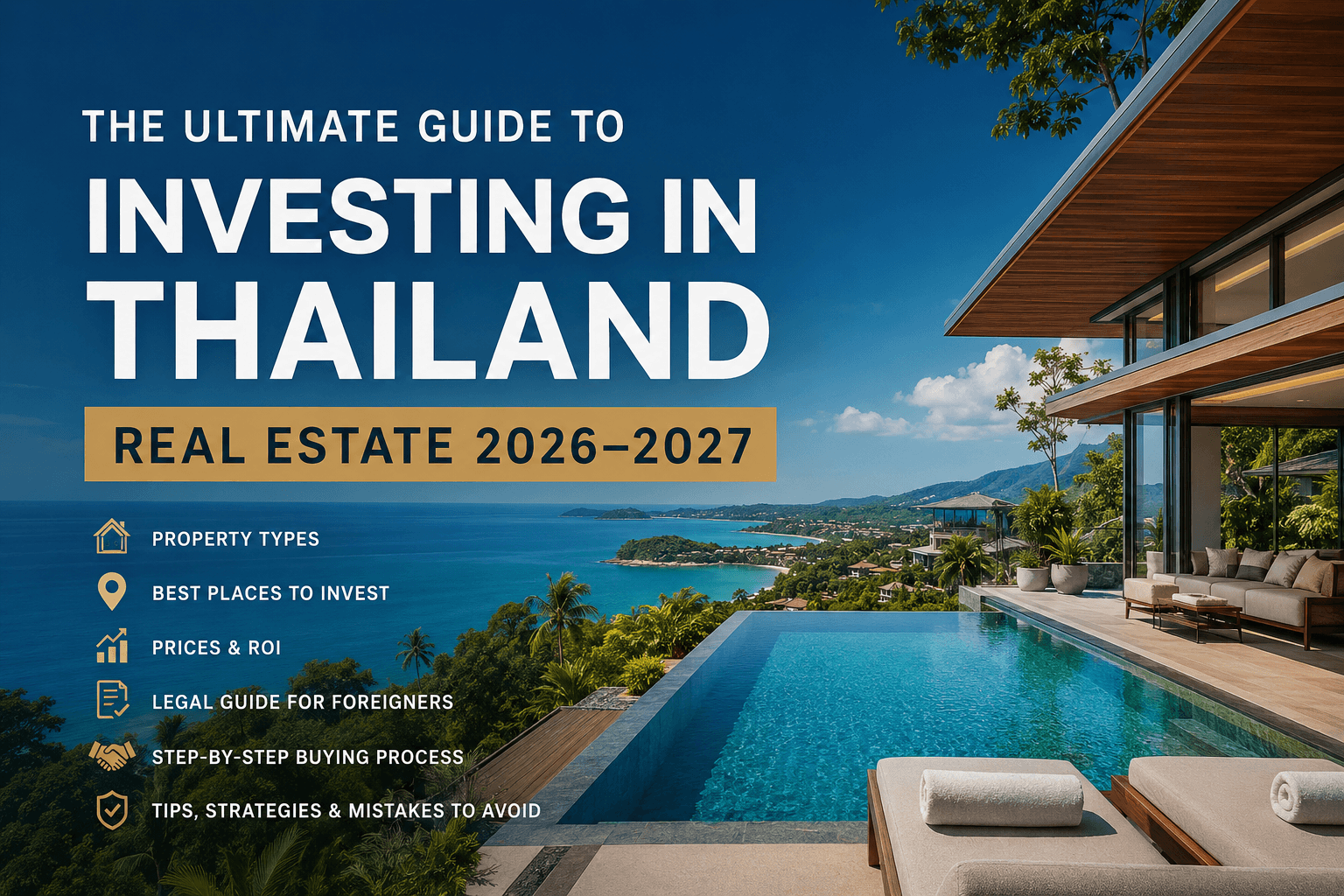
Thailand Property Investment Guide 2026–2027: Everything Foreign Investors Need to Know Before Buying Real Estate
Thailand continues to attract international property investors thanks to its affordable luxury real estate, strong tourism sector, attractive rental yields, and exceptional lifestyle. However, purchasing property in Thailand differs significantly from buying real estate in Europe or the Middle East. Understanding foreign ownership rules, taxes, legal due diligence, and the differences between leasehold and freehold ownership is essential before making an investment. This comprehensive guide explains everything foreign investors need to know about the Thai property market in 2026 and 2027. From choosing the right location to understanding legal structures and maximizing rental returns, you’ll learn how to invest safely and build a profitable property portfolio in one of Asia’s most desirable destinations.
Thailand Property Investment Guide 2026–2027: Everything Foreign Investors Need to Know Before Buying Real Estate
Introduction
Thailand has long been recognized as one of the world’s most desirable destinations for tourism, retirement, and luxury living. Millions of international visitors arrive every year to experience its tropical beaches, vibrant cities, world-class hospitality, and affordable lifestyle. But beyond tourism, Thailand has quietly established itself as one of Southeast Asia’s most attractive real estate investment markets.
For international investors seeking portfolio diversification, recurring rental income, and long-term capital appreciation, Thailand presents a unique opportunity. Compared to many European markets, property prices remain relatively accessible, while demand from tourists, digital nomads, retirees, and expatriates continues to support a healthy rental market.
Among Thailand’s many investment destinations, Phuket, Koh Samui, Bangkok, and Pattaya have become particularly popular with foreign buyers. Each offers distinct advantages depending on your investment goals, whether you’re looking for holiday rental income, long-term tenants, personal use, or future capital growth.
However, purchasing property in Thailand is not as straightforward as buying real estate in Europe, North America, or the UAE. Foreign ownership regulations, legal structures, taxation, financing, and due diligence requirements differ significantly. Understanding these differences before investing is essential to protecting your capital and maximizing returns.
This comprehensive guide has been created specifically for international investors considering Thailand in 2026 and 2027. Whether you’re purchasing your first overseas property or expanding an existing international portfolio, you’ll gain a practical understanding of how the Thai property market works and how to invest with confidence.
Throughout this guide, we’ll explain:
- How foreigners can legally purchase property in Thailand
- The differences between freehold and leasehold ownership
- Which locations currently offer the strongest investment potential
- Typical property prices across major destinations
- Expected rental yields and capital appreciation
- Taxes, fees, and ongoing ownership costs
- Legal due diligence every buyer should complete
- Common mistakes international investors make
- Strategies used by experienced overseas buyers
Rather than focusing solely on property sales, this guide aims to provide transparent, educational information that helps investors make informed decisions based on their financial goals and risk tolerance.
Why Thailand Is Becoming One of Asia’s Most Attractive Property Investment Destinations
The global property investment landscape has changed dramatically over the past decade. Investors are increasingly looking beyond their domestic markets in search of stronger returns, greater diversification, and assets located in countries with growing international appeal.
Thailand continues to stand out for several compelling reasons.
Strong Tourism Drives Consistent Rental Demand
Tourism remains one of Thailand’s strongest economic pillars. Millions of international travelers visit every year, creating continuous demand for short-term accommodation across the country’s most popular destinations.
Unlike purely residential markets, many Thai properties benefit from both owner-occupiers and holiday rental guests. This allows investors to generate income while retaining the flexibility to use the property personally throughout the year.
Luxury villas in Phuket, beachfront condominiums in Pattaya, and premium apartments in Bangkok often attract visitors from Europe, Australia, the Middle East, Singapore, Hong Kong, and increasingly India and China.
As tourism continues recovering and expanding, rental demand remains one of the strongest drivers supporting Thailand’s real estate market.
Affordable Entry Compared to Other International Markets
One of Thailand’s greatest advantages is affordability.
Compared with established international investment destinations such as Dubai, Singapore, London, Sydney, or many Western European cities, investors can often acquire premium properties for a significantly lower capital outlay.
This lower entry price enables buyers to diversify their investment portfolio without committing the level of capital required in more expensive markets.
Many investors also appreciate the opportunity to purchase newly built, fully furnished condominiums with resort-style facilities at prices that would only secure much smaller apartments in other global cities.
Attractive Lifestyle Creates Long-Term Demand
Property values are ultimately driven by people wanting to live, work, retire, or spend time in a location.
Thailand continues to rank among Asia’s most desirable lifestyle destinations thanks to its combination of tropical climate, modern healthcare, international schools, excellent hospitality, reliable infrastructure, and comparatively low cost of living.
Remote workers, entrepreneurs, retirees, and long-term visitors increasingly choose Thailand not simply as a holiday destination but as a place to live for several months—or even permanently.
This expanding international community contributes to both rental demand and long-term property value growth.
Growing Luxury Real Estate Market
While Thailand has traditionally been known for affordable holiday homes, recent years have seen substantial growth in the luxury property segment.
International developers are delivering premium beachfront residences, branded developments, wellness-focused communities, and architecturally distinctive villas that compete with luxury projects found anywhere in Asia.
Buyers seeking second homes increasingly value quality construction, professional management, concierge services, and resort-style amenities.
This evolution has expanded Thailand’s appeal beyond budget-conscious buyers to high-net-worth investors seeking lifestyle assets with income potential.
Stable Long-Term Investment Perspective
Although no real estate market is entirely without risk, Thailand has demonstrated remarkable resilience over multiple economic cycles.
Its diversified economy, mature tourism industry, strong international reputation, and continued infrastructure investment support long-term confidence among domestic and international buyers.
Unlike speculative markets driven primarily by short-term price appreciation, many investors view Thailand as a market where rental income, lifestyle value, and gradual capital appreciation combine to produce attractive overall returns.
Increasing International Accessibility
Thailand has invested heavily in airports, highways, public transport, and tourism infrastructure over the past decade.
Bangkok remains one of Asia’s largest aviation hubs, while Phuket International Airport continues expanding its international connectivity.
Improved accessibility benefits property investors because it increases tourism, supports business activity, and attracts a broader international audience.
For overseas buyers, easier travel also makes it more practical to inspect, manage, and enjoy their investments.
Diversification Beyond Traditional Markets
Many investors already own property in their home country. Others have expanded into destinations such as Dubai, Spain, or Portugal.
Thailand offers geographic diversification while providing exposure to a different economic environment and tourism-driven rental market.
A diversified international portfolio can reduce reliance on a single country’s property cycle and potentially improve long-term investment resilience.
For many investors, Thailand complements existing real estate holdings rather than replacing them.
A Market That Rewards Preparation
While Thailand offers exciting opportunities, success depends on understanding the local market rather than relying on assumptions based on property purchases elsewhere.
Foreign ownership regulations, legal due diligence, payment structures, developer selection, and location analysis all play a critical role in investment performance.
The investors who consistently achieve the best outcomes are those who approach Thailand with a long-term strategy, realistic expectations, and guidance from experienced professionals.
In the following chapters, we’ll explore exactly how foreigners can purchase property in Thailand, the legal structures available, the differences between freehold and leasehold ownership, and how to identify opportunities that align with your investment objectives.
Thailand Real Estate Market Overview (2026–2027)
Before investing in any overseas property market, understanding the broader economic landscape is just as important as choosing the right project. Real estate prices are influenced by factors such as tourism, foreign investment, infrastructure development, employment, demographics, and government policy.
Thailand’s property market has matured significantly over the past two decades. Today, it is no longer viewed solely as a destination for holiday homes. Instead, it has become a diverse real estate market that attracts lifestyle buyers, retirees, digital nomads, high-net-worth individuals, and international investors looking for long-term opportunities.
While global economic uncertainty continues to influence investor sentiment, Thailand’s residential property sector remains supported by strong tourism fundamentals, ongoing infrastructure investment, and sustained foreign demand—particularly in premium condominium developments. International property consultancies expect the luxury condominium segment to remain one of the strongest-performing areas of the market in 2026, with developers increasingly focusing on high-end projects aimed at overseas buyers. (cbre.co.th)
A Market Driven by Multiple Sources of Demand
Unlike many countries that rely primarily on domestic buyers, Thailand benefits from several independent demand drivers.
The first is the local population, particularly buyers purchasing homes for personal use in Bangkok and other major cities.
The second is the tourism industry, which fuels demand for holiday rentals across destinations such as Phuket, Koh Samui, Pattaya, and Hua Hin.
The third is the growing expatriate community, including professionals, entrepreneurs, retirees, and remote workers who choose Thailand for its quality of life and comparatively low living costs.
Finally, foreign investors continue to play an important role in the condominium market. International buyers from China, Russia, Europe, the Middle East, India, Singapore, Hong Kong, and other Asian countries remain active, especially in prime lifestyle destinations. Foreign demand continues to be a major source of support for Thailand’s residential sector. (Cushman & Wakefield)
Tourism Remains One of Thailand’s Greatest Strengths
Tourism has always been one of the strongest pillars supporting Thailand’s property market.
Millions of visitors arrive each year for holidays, business, wellness tourism, retirement planning, and extended stays. Unlike purely residential markets, many investment properties in Thailand benefit directly from tourism through short-term rental demand.
For investors, this creates multiple exit strategies.
A condominium purchased today may be:
- A holiday home
- A short-term rental property
- A long-term rental investment
- A retirement residence
- A resale asset after several years of appreciation
This flexibility makes Thai real estate particularly attractive compared to markets where demand depends almost entirely on local owner-occupiers.
Luxury Development Is Changing the Market
The image of Thailand as a destination filled only with inexpensive apartments has changed dramatically.
Over the last decade, developers have increasingly focused on premium residential communities featuring:
- Beachfront condominiums
- Branded residences
- Wellness-focused developments
- Luxury villas
- Smart-home technology
- Resort-style amenities
- Professional rental management
International brands are entering the market, while local developers continue raising construction quality and design standards.
This shift has attracted a new generation of investors who expect not only attractive prices but also world-class architecture, premium facilities, and professional property management.
According to CBRE, luxury and super-luxury condominiums continue to outperform much of the broader residential market, with strong sales rates supporting further premium launches and price growth in prime locations. (cbre.co.th)
Infrastructure Investment Supports Long-Term Growth
Infrastructure is one of the strongest indicators of future property appreciation.
Thailand continues investing heavily in:
- Airport expansion
- Highway improvements
- Rail connections
- Urban public transportation
- Smart city initiatives
- Healthcare facilities
- International schools
Bangkok’s metro network continues expanding, Phuket International Airport continues improving connectivity, and numerous regional infrastructure projects are making previously overlooked locations increasingly attractive for investment.
Historically, improved accessibility has been one of the biggest drivers of property appreciation worldwide.
Different Cities Offer Different Investment Strategies
One of Thailand’s greatest advantages is that investors can choose from several very different markets.
Bangkok
Thailand’s capital offers the country’s deepest residential market. Demand comes from local professionals, expatriates, multinational companies, universities, and international businesses.
Investors typically focus on:
- Long-term rental income
- Corporate tenants
- Capital appreciation
- Prime city-centre condominiums
Phuket
Phuket is Thailand’s largest island and arguably its strongest international investment destination.
Here, investors often prioritise:
- Holiday rentals
- Luxury villas
- Beachfront condominiums
- Lifestyle investments
- High tourism occupancy
Because Phuket attracts visitors year-round from multiple international markets, it offers one of the most dynamic rental markets in Southeast Asia.
Koh Samui
Koh Samui appeals to buyers seeking exclusivity and a more relaxed atmosphere.
The island has experienced increasing interest from luxury travellers, retirees, and long-stay visitors.
Property supply remains more limited than Phuket, which can support long-term price growth in well-located developments.
Pattaya
Pattaya has evolved far beyond its historical tourism reputation.
Today it benefits from:
- Infrastructure improvements
- The Eastern Economic Corridor (EEC)
- International schools
- Growing expatriate communities
- Increasing business activity
This has diversified rental demand beyond traditional tourism.
Hua Hin
Hua Hin remains popular among retirees and second-home buyers.
Although generally less aggressive from an investment perspective, it offers stability and lifestyle appeal.
Supply Is Becoming More Selective
Following several years of rapid development, many developers have become increasingly disciplined regarding new launches.
Rather than flooding the market with new projects, many are concentrating on:
- Better locations
- Higher-quality construction
- Premium facilities
- Smaller boutique developments
- Luxury positioning
This shift generally benefits investors because excessive supply can reduce rental yields and slow capital appreciation.
Current market research indicates that developers are increasingly targeting premium segments where demand has remained comparatively resilient, while limiting launches in weaker price categories. (Cushman & Wakefield)
What Does This Mean for Investors?
Thailand should not be viewed as a market where every property automatically delivers strong returns.
Instead, successful investing depends on selecting:
- The right location
- The right developer
- The right ownership structure
- The right payment plan
- The right exit strategy
Investors who conduct proper due diligence and focus on high-quality developments in established locations are generally better positioned to benefit from long-term rental demand and capital appreciation.
The Thai property market continues to evolve. Rather than chasing speculative opportunities, many experienced international investors now focus on professionally managed developments in destinations with proven tourism demand, limited premium supply, and strong long-term fundamentals.
In the next chapter, we’ll examine one of the most important questions every international buyer asks: Can foreigners legally buy property in Thailand, and what ownership options are actually available?
Can Foreigners Buy Property in Thailand?
One of the first questions international buyers ask is simple:
“Can foreigners legally own property in Thailand?”
The short answer is yes—but not in the same way they might in Europe, North America, Australia, or the UAE.
Thailand has specific laws governing foreign ownership of real estate. While these rules may seem restrictive at first, they have been in place for decades and provide clear legal pathways for overseas investors to purchase and own certain types of property.
The key is understanding what you can own, what you cannot own directly, and which ownership structure best suits your investment goals.
Many misconceptions about Thai real estate originate from outdated information or oversimplified advice found online. Statements such as “foreigners cannot buy property in Thailand” or “you need to marry a Thai citizen” are inaccurate when taken at face value.
In reality, thousands of foreign buyers purchase property in Thailand every year through legally recognised ownership structures.
Understanding the Difference Between Land and Buildings
One of the most important concepts in Thai property law is the distinction between land ownership and building ownership.
In many countries, when you purchase a house, you automatically own both the land and the building.
Thailand treats these as separate legal assets.
This distinction is fundamental because Thai law places restrictions on foreign ownership of land, while allowing foreign ownership of certain buildings under specific conditions.
Understanding this difference helps explain why condominiums are generally much easier for foreigners to purchase than standalone villas.
Can Foreigners Own Condominiums?
Yes.
Condominiums are by far the most common and straightforward property type for international investors.
Thailand’s Condominium Act allows foreigners to own condominium units in freehold, provided certain legal requirements are met.
The most important rule is the foreign ownership quota.
Within a condominium project, a maximum percentage of the total saleable unit area may be owned by foreign buyers. Once that allocation has been fully sold, additional foreign purchasers cannot register freehold ownership unless units become available again within the foreign quota.
For investors, this means it is important to verify the quota status before signing a reservation agreement.
Experienced developers and legal advisers normally confirm this during the purchasing process.
What Does Freehold Mean?
Freehold is the strongest form of ownership available to foreign condominium buyers.
When you purchase a freehold condominium, you become the registered owner of the unit.
You may generally:
- Sell the property
- Rent it out
- Renovate the interior (subject to building regulations)
- Leave it to your heirs
- Hold it for an unlimited period
Many international investors specifically seek freehold ownership because it provides long-term security and can simplify future resale.
However, not every project offers foreign freehold availability, especially if the foreign ownership quota has already been filled.
Can Foreigners Buy Villas?
This is where many buyers become confused.
A foreigner can purchase and own the building of a villa, but cannot generally own the land underneath it directly.
As a result, villa purchases usually involve one of several legal structures.
The most common is a long-term leasehold agreement, where the foreign buyer leases the land while owning the building constructed on it.
Many high-quality villa developments have been specifically designed around this structure and have successfully served international buyers for many years.
The legal documentation, lease registration, and contractual protections should always be reviewed by an independent lawyer before proceeding.
Understanding Leasehold Ownership
Leasehold often causes concern among first-time investors because the concept differs from ownership structures used in many Western countries.
However, leasehold is widely used across Asia and can be an appropriate solution depending on the buyer’s objectives.
With a leasehold purchase, the investor does not own the land itself.
Instead, they receive the legal right to occupy and use the land for the duration specified in the lease agreement.
A properly structured lease can still allow owners to:
- Live in the property
- Rent it to tenants
- Sell their remaining lease interest
- Benefit from capital appreciation of the property itself
The quality of the legal documentation is extremely important.
Not all lease agreements are identical, which is why professional legal due diligence should never be skipped.
Are There Exceptions?
Over the years, various legal structures have been used for foreign ownership, including company ownership arrangements and other specialised solutions.
Some may be entirely legitimate for certain commercial purposes, while others can introduce unnecessary legal complexity or regulatory risk if used solely to bypass ownership restrictions.
Investors should be cautious of anyone promoting “easy loopholes” or guaranteeing structures that appear to circumvent Thai property law.
If a solution sounds too good to be true, it deserves careful legal review.
For most international buyers purchasing residential property, straightforward condominium freehold ownership or professionally structured villa leasehold arrangements remain the most common and practical options.
How Are Payments Made?
Another important legal requirement concerns the transfer of purchase funds.
For foreign freehold condominium purchases, buyers are generally required to transfer funds from overseas in foreign currency before completion.
Banks issue documentation confirming the source and purpose of the transfer, which forms part of the registration process.
Keeping clear financial records is important not only for ownership registration but also for any future resale.
Your lawyer and the developer’s sales team will normally guide you through the required documentation.
Can You Finance a Property in Thailand?
Unlike some international markets, mortgage availability for foreign buyers remains relatively limited.
Although certain financial institutions may offer lending solutions under specific circumstances, many overseas purchasers acquire Thai property using cash or developer payment plans during the construction phase.
Off-plan developments have become particularly popular because staged payment schedules reduce the amount of capital required upfront while allowing buyers to spread payments over the construction period.
We’ll examine financing options in greater detail later in this guide.
Why Legal Due Diligence Matters
No matter which ownership structure you choose, legal due diligence should always be considered an essential part of the purchasing process.
A qualified independent property lawyer should verify matters such as:
- Land title documentation
- Building permits
- Developer credentials
- Ownership structure
- Contract terms
- Payment schedule
- Existing encumbrances
- Registration procedures
Skipping legal review to save a relatively small amount of money can expose buyers to significantly greater financial risks later.
Professional due diligence provides confidence that the transaction is structured correctly and that the property can be transferred according to Thai law.
Which Ownership Structure Is Right for You?
There is no single answer that suits every investor.
Your ideal ownership structure depends on your objectives.
If your priority is straightforward ownership, long-term security, and easier resale, a foreign freehold condominium may be the best choice.
If you’re seeking a luxury villa with greater privacy, larger living space, and lifestyle appeal, a professionally structured leasehold villa may better align with your goals.
Rather than asking which ownership model is universally “better,” experienced investors usually ask a different question:
Which structure best supports my investment strategy?
Once that question is answered, selecting the right property becomes significantly easier.
In the next chapter, we’ll explore one of the biggest decisions every buyer faces: Should you invest in a condominium or a villa? We’ll compare rental demand, maintenance costs, appreciation potential, management requirements, and the type of investor each property is best suited for.
Condominium vs Villa: Which Property Type Is the Better Investment in Thailand?
One of the biggest decisions every investor faces is not whether to invest in Thailand, but what to invest in.
Should you purchase a condominium in a managed development or invest in a private villa?
Both options can be excellent investments, but they serve very different purposes. Your ideal choice depends on your investment objectives, budget, risk tolerance, expected rental strategy, and how involved you want to be in managing the property.
There is no universal “best” property type. Instead, successful investors choose the asset that aligns with their long-term financial goals.
In this chapter, we’ll compare condominiums and villas across the factors that matter most.
Condominiums: The Most Popular Choice for International Investors
Condominiums account for the majority of foreign property purchases in Thailand, and for good reason.
They offer a straightforward ownership process, lower entry prices, professional management, and strong rental demand in many of the country’s most popular destinations.
Most newly built condominiums include facilities such as:
- Swimming pools
- Fitness centres
- Co-working spaces
- Concierge services
- 24-hour security
- Reception areas
- Parking
- Landscaped gardens
- Children’s play areas
- Rooftop lounges
These amenities make condominiums attractive not only to tourists but also to digital nomads, long-term renters, and expatriates.
For investors living overseas, professionally managed buildings can significantly reduce the day-to-day responsibilities of property ownership.
Advantages of Investing in a Condominium
Easier Ownership for Foreign Buyers
As discussed in the previous chapter, foreigners can legally own condominium units in freehold, provided the project’s foreign ownership quota has not been exceeded.
This makes condominiums the simplest and most transparent option for many international investors.
Lower Initial Investment
Compared with villas, condominiums generally require a lower capital investment.
This allows investors to:
- Enter the Thai market with a smaller budget
- Diversify across multiple properties
- Reduce overall investment risk
- Maintain greater liquidity
For first-time overseas investors, this lower entry point is often a significant advantage.
Strong Rental Demand
Well-located condominiums attract a wide variety of tenants, including:
- Tourists
- Digital nomads
- Corporate professionals
- Retirees
- Long-term expatriates
Depending on the location, investors may choose between short-term holiday rentals (where permitted) or long-term leasing strategies.
Lower Maintenance Responsibilities
One of the greatest benefits of condominium ownership is convenience.
Building management typically handles:
- Security
- Common areas
- Landscaping
- Swimming pools
- Elevators
- Facility maintenance
- Cleaning of shared spaces
Owners simply pay a maintenance fee while avoiding many of the responsibilities associated with standalone homes.
Potential Disadvantages of Condominiums
No investment is perfect.
Condominium owners should also consider:
- Monthly common area maintenance fees
- Less privacy than private villas
- Building regulations governing renovations
- Potential competition from similar units within the same development
Selecting a well-managed project with a reputable developer is therefore essential.
Villas: Luxury, Privacy and Lifestyle
For many buyers, owning a tropical villa represents the ultimate dream.
Imagine waking up beside your private swimming pool, surrounded by lush gardens just minutes from the beach.
Thailand’s luxury villa market has grown significantly over the past decade, particularly in Phuket and Koh Samui.
Many developments now combine private residences with professional resort management, offering owners both lifestyle benefits and rental income opportunities.
Advantages of Investing in a Villa
Greater Privacy
One of the biggest attractions of villa ownership is privacy.
Unlike apartment living, villas typically provide:
- Private swimming pools
- Private gardens
- Larger outdoor living areas
- No shared walls
- More peaceful surroundings
For many high-end travellers, these features justify paying substantially higher nightly rental rates.
Premium Rental Income Potential
Luxury villas often generate impressive rental income during peak tourism seasons.
Families, groups of friends, wedding parties, and affluent holidaymakers frequently prefer villas over hotel rooms because they offer:
- More space
- Better privacy
- Fully equipped kitchens
- Outdoor entertaining areas
- Exclusive facilities
Although occupancy may fluctuate more than condominiums, successful villa investments can achieve strong average nightly rates.
Larger Living Space
For buyers intending to spend several months each year in Thailand, villas offer a completely different lifestyle experience.
Many include:
- Three to six bedrooms
- Home offices
- Outdoor dining areas
- Entertainment rooms
- Private parking
- Landscaped gardens
This makes them particularly attractive to families and retirees.
Limited Supply Can Support Appreciation
Prime beachfront land is finite.
In destinations such as Phuket and Koh Samui, opportunities to develop new luxury villas in premium locations continue to decrease.
Scarcity can contribute to long-term capital appreciation for high-quality villa developments.
Challenges of Villa Ownership
While villas offer many advantages, they also require greater consideration.
Owners should account for:
- Higher purchase prices
- Private pool maintenance
- Garden maintenance
- Building upkeep
- Insurance
- Utility management
- Property supervision while vacant
Unless the property is professionally managed, these responsibilities can become time-consuming for overseas owners.
Rental Performance: Condo vs Villa
Rental performance depends heavily on location, property quality, and management rather than property type alone.
Generally speaking:
Condominiums
- Broader tenant base
- More consistent occupancy
- Lower nightly rates
- Easier management
- Strong appeal to solo travellers, couples, and professionals
Villas
- Higher nightly rental potential
- Greater seasonal variation
- More operational complexity
- Higher maintenance costs
- Popular with families and luxury travellers
Many experienced investors choose based on their preferred balance between simplicity and income potential.
Which Property Appreciates More?
There is no definitive answer.
Capital appreciation depends on numerous factors, including:
- Location
- Infrastructure improvements
- Developer reputation
- Construction quality
- Market timing
- Supply and demand
A premium condominium in central Bangkok may outperform an average villa in a secondary location.
Likewise, an exceptional beachfront villa in Phuket could significantly outperform many condominiums over the long term.
The quality of the asset matters far more than the property category itself.
Which Investment Fits Your Goals?
A condominium may be the right choice if you:
- Are buying your first overseas property
- Want the simplest ownership structure
- Prefer lower maintenance
- Plan to rent to a broad tenant market
- Have a moderate investment budget
A villa may be ideal if you:
- Prioritise lifestyle and privacy
- Intend to spend extended periods in Thailand
- Target the luxury rental market
- Have a larger investment budget
- Are comfortable with more active property management or using a professional management company
A Growing Trend: Resort-Managed Developments
One of the fastest-growing segments of Thailand’s property market combines the advantages of both property types.
Modern resort-managed developments offer:
- Professionally managed condominiums
- Private villas within gated communities
- Rental management programmes
- Concierge services
- Hotel-style facilities
- Maintenance teams
- Marketing support for holiday rentals
These projects appeal particularly to international investors because they reduce operational complexity while helping maximise occupancy and rental income.
The Bottom Line
Choosing between a condominium and a villa is not about identifying a universally superior investment.
Instead, it’s about selecting the property that best matches your financial objectives, lifestyle preferences, and long-term strategy.
For many first-time international investors, a well-located freehold condominium provides an excellent introduction to the Thai property market.
For experienced investors seeking exclusivity, higher-end rental potential, and a luxury lifestyle, a professionally managed villa can be an outstanding addition to an international portfolio.
The most successful investors don’t simply buy the property they like the most—they buy the property that best supports their investment goals.
In the next chapter, we’ll explore the best places to invest in Thailand, beginning with Phuket, Bangkok, Koh Samui, Pattaya, and Hua Hin. We’ll examine property prices, rental demand, future infrastructure, target tenants, and which type of investor each destination is best suited for.
The Best Places to Invest in Thailand (2026–2027)
One of Thailand’s greatest strengths as a property investment destination is its diversity. Unlike smaller markets where investment opportunities are concentrated in a single city, Thailand offers several distinct regions, each with its own economic drivers, buyer profiles, rental markets, and long-term growth potential.
Choosing the right location is arguably more important than choosing the property itself. A well-located condominium from a reputable developer will often outperform a larger property in a weaker location.
Before selecting a project, investors should consider:
- Who will rent the property?
- Is demand driven by tourism, business, or long-term residents?
- What infrastructure projects are planned?
- Is there limited future supply?
- What type of appreciation is expected over the next 10–15 years?
Let’s explore Thailand’s strongest investment destinations.
Phuket – Thailand’s Premier International Investment Destination
If there is one market that consistently attracts international property investors, it is Phuket.
Often referred to as the “Pearl of the Andaman,” Phuket combines world-class beaches, luxury resorts, modern infrastructure, international schools, private hospitals, marinas, golf courses, and one of Asia’s strongest tourism industries.
Unlike many holiday destinations that experience only seasonal demand, Phuket enjoys a long tourism calendar supported by visitors from Europe, the Middle East, Australia, India, China, Russia, and Southeast Asia.
This diversified visitor base helps support year-round rental demand.
Why Investors Choose Phuket
Phuket appeals to a wide range of buyers because it offers multiple investment strategies:
- Holiday rental properties
- Luxury villas
- Resort-managed condominiums
- Retirement homes
- Second residences
- Long-term rental investments
It is also one of Thailand’s most internationally recognised property markets, making resale opportunities generally stronger than in less established destinations.
Best Areas in Phuket
Bang Tao
Bang Tao has transformed into Phuket’s luxury lifestyle hub.
The area is home to:
- Premium beach clubs
- International restaurants
- Golf courses
- Luxury resorts
- Wellness centres
- High-end residential developments
Buyers looking for premium appreciation often focus here.
Laguna Phuket
Laguna is one of Asia’s most established integrated resort communities.
The area combines hotels, golf courses, lakes, luxury residences, and managed rental programmes, making it attractive to investors seeking a professionally operated environment.
Nai Harn
Nai Harn offers a quieter atmosphere while remaining close to one of Phuket’s most beautiful beaches.
Demand is driven by:
- Families
- Long-term residents
- Digital nomads
- Retirees
Properties here often appeal to buyers seeking lifestyle as much as investment.
Rawai
Rawai has experienced significant growth over the past decade.
It attracts buyers looking for:
- Larger living spaces
- Villas
- Marina access
- Family-friendly neighbourhoods
It also serves as a gateway to nearby islands.
Kata & Karon
These long-established tourism destinations continue attracting strong visitor numbers.
Beachfront proximity supports healthy holiday rental demand throughout much of the year.
Kamala
Kamala has become synonymous with luxury hillside villas offering panoramic sea views.
Many ultra-high-net-worth buyers choose this area for exclusive residences.
Investment Outlook for Phuket
Phuket remains one of Thailand’s strongest long-term investment markets because demand comes from multiple international buyer groups rather than relying on a single country or demographic.
Luxury developments, limited beachfront land, growing infrastructure, and continued tourism recovery continue supporting long-term confidence.
Bangkok – Thailand’s Economic Powerhouse
While Phuket dominates lifestyle investments, Bangkok remains Thailand’s financial and commercial centre.
Unlike tourism-driven markets, Bangkok benefits from demand generated by:
- Thai professionals
- Multinational corporations
- Universities
- Government institutions
- Regional headquarters
- Expatriates
This creates a fundamentally different rental market.
Rather than holiday accommodation, investors typically focus on long-term residential tenants.
Best Areas in Bangkok
Popular investment districts include:
- Sukhumvit
- Thonglor
- Ekkamai
- Silom
- Sathorn
- Riverside
- Phrom Phong
- Asoke
Properties close to BTS and MRT stations generally command stronger rental demand.
Why Investors Choose Bangkok
Bangkok offers:
- Strong corporate rental demand
- Stable occupancy
- High liquidity
- Large resale market
- Continuous infrastructure expansion
Although rental yields may differ from holiday markets, Bangkok often appeals to investors prioritising long-term stability.
Koh Samui – Boutique Luxury with Long-Term Potential
Koh Samui has evolved into one of Thailand’s most exclusive island destinations.
Unlike Phuket, development remains more limited.
Many investors view this restricted supply as one of the island’s greatest advantages.
Luxury tourism continues expanding while premium land remains relatively scarce.
Why Investors Like Koh Samui
The island attracts:
- Luxury travellers
- Honeymoon visitors
- Wellness tourists
- Retirees
- Digital entrepreneurs
Many buyers are not purely investment-driven—they are also purchasing a future lifestyle property.
Popular Areas
- Bophut
- Chaweng
- Choeng Mon
- Lamai
- Maenam
Each offers a different balance between tourism activity and residential appeal.
Pattaya – More Than a Weekend Destination
Pattaya has changed dramatically over the past decade.
Large infrastructure investments, the Eastern Economic Corridor (EEC), improved transportation links, and increasing international business activity have transformed the city’s image.
Today, demand comes from:
- Professionals
- Expatriates
- Families
- Long-term residents
- Investors
rather than relying solely on tourism.
Why Pattaya Is Growing
Key growth drivers include:
- Infrastructure investment
- High-speed rail proposals
- Industrial expansion
- International schools
- Healthcare facilities
- Strong condominium supply
Entry prices often remain lower than Phuket while offering attractive rental opportunities.
Hua Hin – Stability and Lifestyle
Located a few hours south of Bangkok, Hua Hin has long been popular among retirees, weekend visitors, and second-home buyers.
The market tends to experience less volatility than heavily tourism-driven destinations.
Although appreciation may be more gradual, Hua Hin offers:
- Relaxed coastal living
- Established infrastructure
- Golf communities
- Family-friendly neighbourhoods
- Stable long-term demand
Emerging Investment Locations
While the five destinations above dominate international interest, several emerging markets deserve attention.
These include:
- Krabi
- Chiang Mai
- Khao Lak
- Rayong
- Phang Nga
Although generally smaller markets, they may offer opportunities for investors willing to adopt a longer-term strategy.
Which Location Is Right for You?
Different investors have different priorities.
If your goal is holiday rentals and international tourism:
Choose Phuket.
If you prefer long-term tenants and business-driven demand:
Bangkok remains the strongest option.
If you’re seeking exclusivity and lifestyle appeal:
Koh Samui offers an attractive balance of luxury and limited supply.
If you’re looking for affordability and future growth:
Pattaya deserves serious consideration.
If stability and retirement demand are your priorities:
Hua Hin may be the ideal fit.
Final Thoughts
There is no single “best” place to invest in Thailand.
The right location depends on your budget, investment horizon, preferred rental strategy, and long-term objectives.
Many experienced international investors eventually diversify across multiple Thai markets, combining the stability of Bangkok with the tourism-driven income potential of Phuket or the exclusivity of Koh Samui.
Understanding the strengths of each destination is the first step toward building a resilient property portfolio.
In the next chapter, we’ll explore property prices across Thailand, comparing condominiums and villas in each major investment destination while examining what buyers can realistically expect at different budget levels.
Property Prices in Thailand (2026–2027)
One of the biggest advantages of investing in Thailand is the wide range of property options available across different budgets. Whether you’re looking for your first overseas investment or adding a luxury beachfront villa to your portfolio, Thailand offers opportunities that are often more affordable than many comparable international destinations.
Unlike markets where prices are relatively uniform, Thailand’s real estate values vary significantly depending on location, proximity to the beach, property type, developer reputation, construction quality, and available amenities.
Understanding these differences is essential before beginning your property search.
What Determines Property Prices?
There is no single “average” property price in Thailand.
Several factors influence value, including:
- Location
- Distance from the beach
- Sea views
- Infrastructure
- Developer reputation
- Building quality
- Unit size
- Available facilities
- Rental demand
- Future supply
For example, two apartments with the same floor area can differ substantially in price simply because one is within walking distance of the beach while the other is located several kilometres inland.
Similarly, projects developed by internationally recognised developers often command higher prices due to stronger construction standards, better management, and increased buyer confidence.
Condominium Prices
Condominiums remain the most accessible property type for international buyers.
Entry-level apartments can often be found in secondary locations at relatively affordable prices, while luxury beachfront developments can reach levels comparable to premium real estate in Europe or Dubai.
For first-time investors, one-bedroom apartments continue to be among the most popular options.
They typically appeal to:
- Holiday renters
- Digital nomads
- Young professionals
- Couples
- Long-term expatriates
Two-bedroom units generally attract families and higher-income tenants, while larger luxury residences target affluent international buyers seeking second homes.
Although prices differ considerably between locations, newly launched off-plan developments often provide the most attractive entry opportunities because buyers purchase before construction is completed.
Villa Prices
Villa investments require a higher initial budget but provide a completely different ownership experience.
Prices depend largely on:
- Land size
- Building size
- Construction quality
- Privacy
- Sea views
- Distance to the coastline
- Community facilities
A modern three-bedroom villa located a short drive from the beach may cost considerably less than a comparable beachfront property.
Sea-view villas, branded residences, and architect-designed luxury homes occupy the premium end of the market and continue attracting international buyers seeking exclusive lifestyle assets.
Phuket Property Prices
Phuket offers one of Thailand’s widest price ranges.
Affordable condominiums remain available in emerging neighbourhoods, while prime beachfront residences rank among the country’s most expensive real estate.
Luxury developments in Bang Tao, Laguna, Kamala, Surin, and selected areas of Nai Harn regularly attract buyers from Europe, the Middle East, Singapore, and Hong Kong.
As available beachfront land becomes increasingly limited, premium developments in these locations continue to command strong prices.
For investors focused on long-term appreciation, location usually matters far more than purchasing the largest possible property.
Bangkok Property Prices
Bangkok’s pricing is heavily influenced by proximity to the city’s business districts and public transportation network.
Properties located within walking distance of BTS or MRT stations generally command higher values because of stronger rental demand.
Prime neighbourhoods such as Sukhumvit, Thonglor, Ekkamai, Sathorn, and Silom remain among the city’s most sought-after residential locations.
Investors often prioritise convenience, transportation, and tenant demand over larger living spaces.
Koh Samui Property Prices
Compared with Phuket, Koh Samui generally offers a more boutique property market.
Limited land availability in prime locations supports pricing for premium developments.
Luxury villas with panoramic sea views continue to attract international buyers looking for exclusivity rather than high-density urban living.
Condominium supply remains more limited than in Phuket, creating opportunities for carefully selected developments that combine quality construction with strong management.
Pattaya Property Prices
Pattaya continues to provide attractive value relative to many other international coastal destinations.
The city offers a broad selection of condominiums at different price points, making it popular among both first-time investors and experienced buyers seeking diversification.
As infrastructure projects continue and the Eastern Economic Corridor develops further, many investors expect selected districts to benefit from increasing demand over the coming years.
Hua Hin Property Prices
Hua Hin generally attracts buyers seeking lifestyle rather than rapid capital appreciation.
Prices remain competitive compared with many international retirement destinations, while premium beachfront communities continue attracting affluent domestic and foreign buyers.
Although the market tends to grow more gradually than Phuket or Bangkok, many investors appreciate its long-term stability.
Off-Plan vs Completed Properties
One of the most important pricing differences in Thailand is whether a property is purchased before or after construction.
Buying off-plan often allows investors to secure lower launch prices before market values increase during the construction period.
Developers typically release projects in phases.
Early buyers may benefit from:
- Lower purchase prices
- Greater unit selection
- Flexible payment schedules
- Higher appreciation potential before completion
Completed properties, on the other hand, allow buyers to inspect exactly what they are purchasing and begin generating rental income immediately.
Neither approach is universally better.
The right decision depends on your investment strategy, available capital, and preferred timeline.
Should You Buy the Cheapest Property?
Many first-time investors naturally focus on finding the lowest possible purchase price.
However, experienced investors usually ask a different question:
Which property is most likely to deliver the strongest long-term return?
A cheaper apartment in a weak location may ultimately underperform a higher-quality property situated in an area with stronger rental demand and better long-term growth prospects.
Price alone should never be the deciding factor.
Instead, investors should evaluate the overall value proposition, including:
- Developer reputation
- Construction quality
- Facilities
- Rental demand
- Future infrastructure
- Neighbourhood development
- Property management
- Exit opportunities
The most successful investments are rarely the cheapest—they are the ones purchased in the right location at the right stage of the market.
Looking Beyond the Purchase Price
The purchase price represents only one part of the overall investment.
Buyers should also consider:
- Legal fees
- Government registration costs
- Maintenance fees
- Sinking fund contributions
- Insurance
- Furnishing (if applicable)
- Property management costs
- Rental marketing expenses
Understanding the full cost of ownership provides a much more accurate picture of potential investment performance.
Next step
Ready to turn insight into action?
Book a free, no-obligation consultation with Benjamin and get a curated shortlist of off-plan opportunities matched to your goals.
Book a Consultation TodayBenjamin Nagy
Off-plan property investment advisor