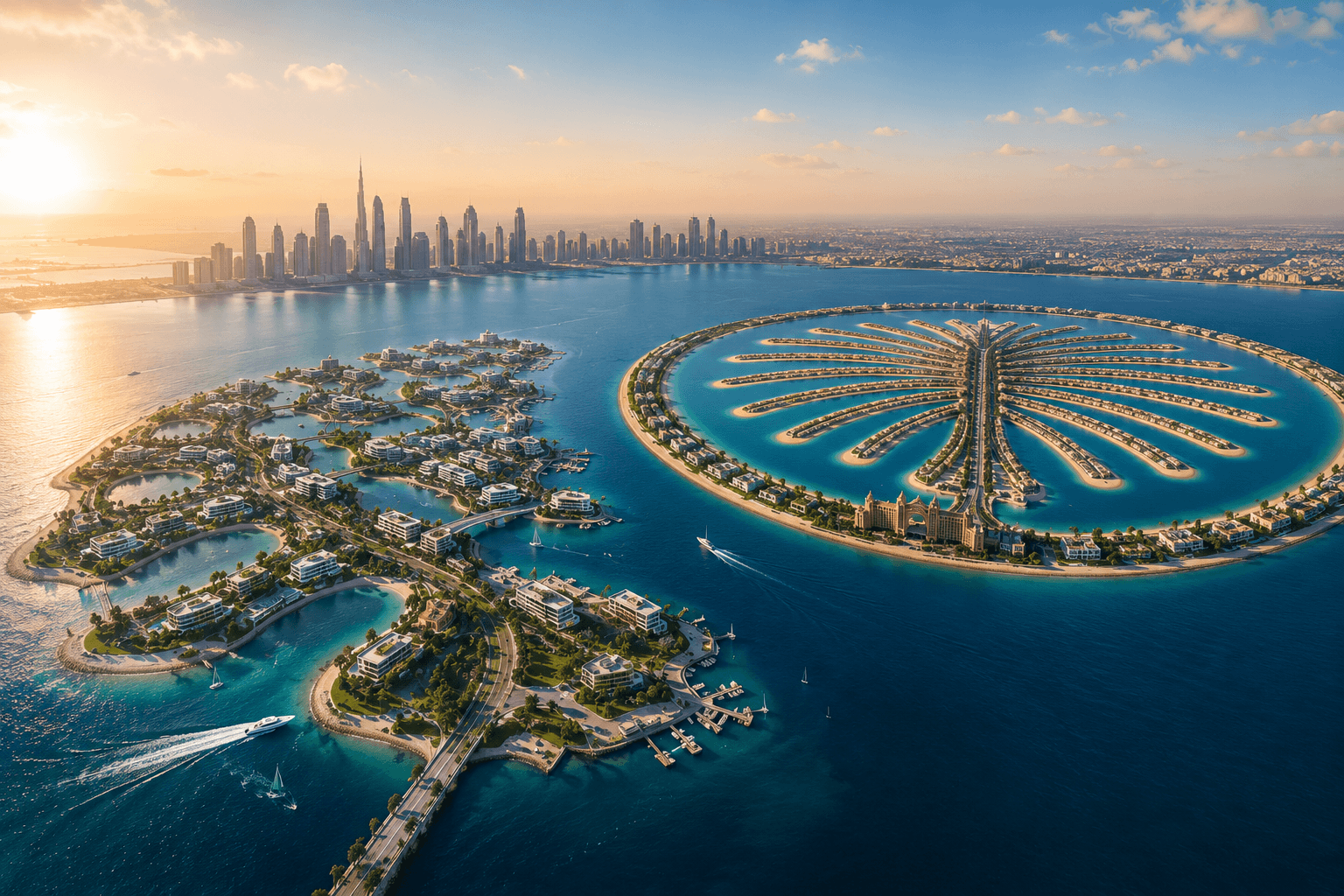
Dubai Islands vs Palm Jebel Ali: Which Waterfront Investment Will Perform Better in 2026?
Two of Dubai’s most talked-about waterfront destinations are competing for investor capital in 2026 — but they are not the same play. Dubai Islands offers near-term delivery and rental-ready upside, while Palm Jebel Ali is a longer-horizon megaproject with explosive appreciation potential. Here’s how to decide which one fits your strategy, your timeline, and your risk appetite.
Dubai Islands vs Palm Jebel Ali: Which Waterfront Investment Will Perform Better in 2026?
Dubai’s waterfront has always commanded a premium. Water views, beach access, and limited supply create the kind of scarcity that drives long-term capital growth — which is exactly why serious investors are paying close attention to the two destinations dominating the 2026 conversation: Dubai Islands and Palm Jebel Ali.
On the surface they look similar: master-planned island communities, beachfront living, branded developments, and the Dubai name behind them. But as an investment, they are almost opposites. One is built for investors who want delivery and rental income within a defined timeframe. The other is built for investors who can afford to wait — and want to capture appreciation from the ground floor of a generational project.
This guide breaks down both, side by side, so you can decide which waterfront play actually fits your strategy in 2026.
Why waterfront still wins in Dubai
Before comparing the two, it’s worth understanding why waterfront property in Dubai behaves differently from inland stock.
Beachfront land is finite. Dubai can keep building communities in the desert almost indefinitely, but it cannot manufacture more coastline without reclaiming it — and reclamation is expensive, slow, and tightly controlled. That structural scarcity is the engine behind waterfront premiums. Units with genuine sea views and direct beach access have historically outperformed comparable inland units on both resale value and rental yield.
For an investor, that means waterfront stock tends to be more resilient in a downturn and faster to recover in an upswing. It is the closest thing Dubai has to a “blue-chip” property category.
the last early-entry opportunity on Dubai Islands
Dubai Islands: the near-term play
Dubai Islands is the redeveloped, rebranded evolution of the former Deira Islands project — a cluster of islands just off the historic Deira coastline, positioned as a lifestyle-led waterfront district with beaches, marinas, hotels, and residential towers.
What makes Dubai Islands attractive to investors in 2026 is timing. Significant infrastructure is already in place or progressing visibly, and a meaningful pipeline of residential product is moving toward handover. For an investor, that shortens the gap between buying and earning. You are not betting on a master plan a decade out — you are buying into a district that is becoming real and rentable inside a realistic horizon.
The investment characteristics tend to be:
- Lower entry tickets than Palm Jebel Ali for comparable unit types, opening the door to a wider pool of buyers.
- Faster route to rental income, because completion and the surrounding ecosystem are closer.
- Strong short-stay potential, given the beach-and-marina lifestyle that appeals to tourists and seasonal renters.
- Liquidity on exit, because a more accessible price point means a larger resale audience.
The trade-off: because the location is closer to maturity, a meaningful slice of the early-stage “discount” may already be priced in. You are buying stability and cash flow more than raw, speculative upside.
Palm Jebel Ali: the long-horizon play
Palm Jebel Ali is the larger, more ambitious sibling of Palm Jumeirah — a vast palm-shaped island development planned to eventually host a substantial residential population, extensive beachfront, and a full lifestyle ecosystem. In scale, it dwarfs the original Palm.
The investment thesis here is different in kind. You are buying very early into a megaproject whose full value will only be realized over many years. History offers a useful reference: early buyers on Palm Jumeirah, before it matured into one of the most prestigious addresses in the world, saw extraordinary appreciation as the island filled in and its reputation cemented.
Palm Jebel Ali’s characteristics tend to be:
- Higher entry tickets, especially for villas and signature beachfront product.
- A longer wait to delivery and to a fully functioning community, which delays rental income.
- Larger appreciation potential if the project delivers on its master plan, precisely because you are entering at the earliest, lowest-priced stage.
- Higher execution risk, simply because more of the value depends on a long build-out that is years from completion.
This is a play for investors with patience, capital that doesn’t need to work immediately, and conviction in Dubai’s long-term trajectory.
Head to head: how to choose
The honest answer is that these two are not really competitors — they are different tools for different jobs.
Choose Dubai Islands if you want: a shorter path to rental income, a lower entry point, strong short-term rental potential, easier resale liquidity, and lower execution risk. It suits investors who want their capital working sooner and prefer cash flow over a long speculative wait.
Choose Palm Jebel Ali if you want: maximum long-term appreciation, are comfortable tying up capital for years, can absorb a higher entry ticket, and want to own a piece of a flagship project from the earliest possible stage. It suits patient capital and conviction buyers.
A genuinely sophisticated investor might do both — using Dubai Islands for near-term yield and liquidity, and a Palm Jebel Ali position for long-horizon capital growth. That barbell approach captures cash flow now and upside later, instead of forcing a single bet.
the best off-plan projects in Dubai for investors
The risks you can’t ignore
No waterfront purchase is risk-free. Two factors matter most:
1. Delivery risk. Off-plan timelines slip. The further the handover date, the more your projected returns depend on factors outside your control. Always check the developer’s track record, the escrow protections in place, and the realism of the construction schedule before committing.
2. Supply timing. A wave of simultaneous handovers in a single district can soften rents temporarily, even in a strong market. Understanding when your unit completes relative to surrounding inventory is part of getting the entry right.
Neither risk is a reason to avoid waterfront — they are reasons to do proper due diligence on the specific unit, building, and developer rather than buying the headline.
The verdict for 2026
If 2026 is the year you want capital actively earning, Dubai Islands is the more rational entry: closer to delivery, more affordable, and built for rental performance.
If you are positioning for the next decade and can wait, Palm Jebel Ali offers the kind of early-stage upside that rarely comes around twice in the same location.
The “better” investment is simply the one that matches your timeline. Define whether you need yield or appreciation first — then the choice between these two islands becomes obvious.
Disclaimer: Property values, yields, and project timelines change over time. Always verify current figures and developer details before making an investment decision.
Benjamin Nagy
Off-plan ingatlan befektetési tanácsadó