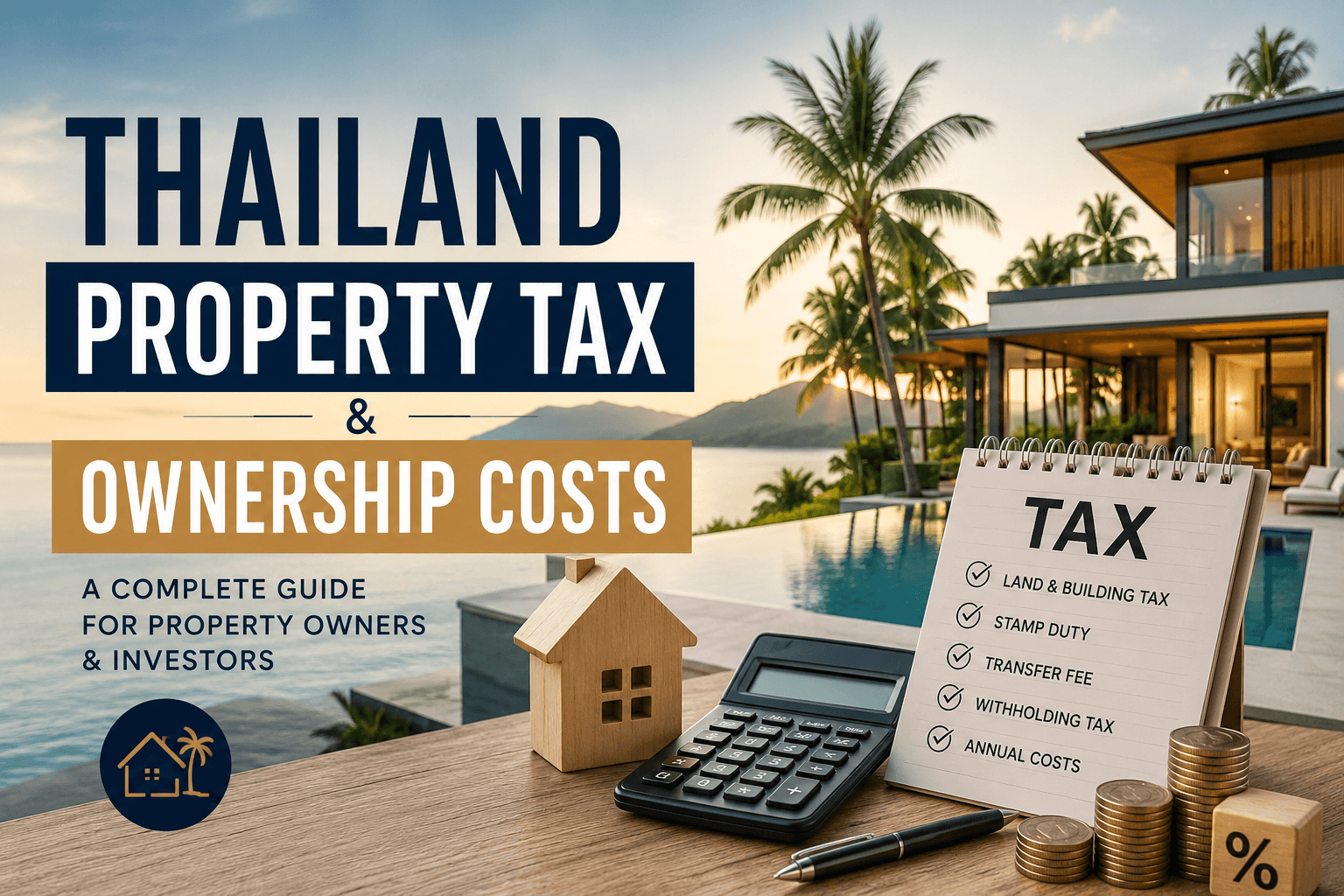
Thailand Property Tax and Ownership Costs in 2026: What Every Foreign Investor Must Know
The purchase price is only the beginning. Before buying property in Thailand, you need to understand the full tax picture — transfer fees, withholding tax, lease registration, and annual holding costs. Here’s the complete breakdown.
Thailand Property Tax and Ownership Costs in 2026: What Every Foreign Investor Must Know
One of the most common mistakes foreign investors make in Thailand is calculating returns based on purchase price alone. The real cost of buying — and holding — property in Thailand includes a layer of taxes and fees that, if ignored, can materially affect your ROI.
This guide breaks down every cost category you need to understand before committing capital to the Thai market in 2026.
Transfer fee
The transfer fee in Thailand is 2% of the appraised value (not the sale price) of the property. This is typically split 50/50 between buyer and seller, though in practice, the split is often negotiated. For a condo unit appraised at 5 million THB, this means 100,000 THB total — 50,000 THB per party.
Withholding tax
The seller pays withholding tax, calculated on a sliding scale based on the appraised value and the number of years the property has been held. This typically ranges from 1–3% of the appraised value for individual sellers. While this is technically the seller’s liability, it affects negotiated pricing and is worth understanding when structuring a deal.
Specific Business Tax (SBT)
If a property is sold within 5 years of acquisition, Specific Business Tax of 3.3% applies (based on the higher of sale price or appraised value). This is a significant cost that affects exit strategy planning — particularly relevant for investors considering a 3–5 year hold period.
Stamp duty
If SBT does not apply (i.e. the property is held for more than 5 years), stamp duty of 0.5% replaces it. This is the more favourable option for long-term holders.
Annual holding costs
Thailand introduced a Land and Building Tax in 2020, replacing older annual fees. For residential properties used as a primary residence, the rate is very low (0.02–0.1%). For investment or rental properties, the rate rises to 0.3–0.7% of the appraised value annually. For a condo with an appraised value of 5 million THB used as a rental, this means approximately 15,000–35,000 THB per year.
Leasehold registration costs
For foreign investors purchasing under a leasehold structure — the most common route for those who cannot hold freehold — lease registration at the Land Department costs 1% of the total lease value. A 30-year lease on a property valued at 5 million THB would therefore attract a 50,000 THB registration fee.
For a full explanation of ownership structures available to foreigners, see our guide on buying property in Thailand as a foreigner and our breakdown of freehold vs leasehold in Thailand.
How this affects your ROI calculation
On a typical Phuket condo purchase at 5 million THB (approximately $140,000 USD), total acquisition costs including transfer fee and lease registration can add 3–5% to your entry cost. Annual holding costs of 0.3–0.7% must be factored into net yield calculations. Gross yields of 7–8% in prime Phuket areas translate to net yields of 5–6.5% after taxes and management fees — still competitive, but the gross number alone is misleading.
For a broader picture of what property actually costs in Thailand, see our complete guide on how much it costs to buy property in Thailand.
Working with the right advisor
Tax structuring in Thailand — particularly around leasehold vs company ownership structures — is an area where specialist advice pays for itself. Ensure your advisor has direct experience with Thai Land Department transactions and understands the interplay between ownership structure and tax liability.
The bottom line
Thailand’s tax environment for property investors is manageable — often more favourable than European markets — but it requires proper upfront planning. Investors who understand the full cost picture before they buy make better decisions, negotiate more effectively, and protect their returns over the full investment cycle.
Benjamin Nagy
Off-plan ingatlan befektetési tanácsadó