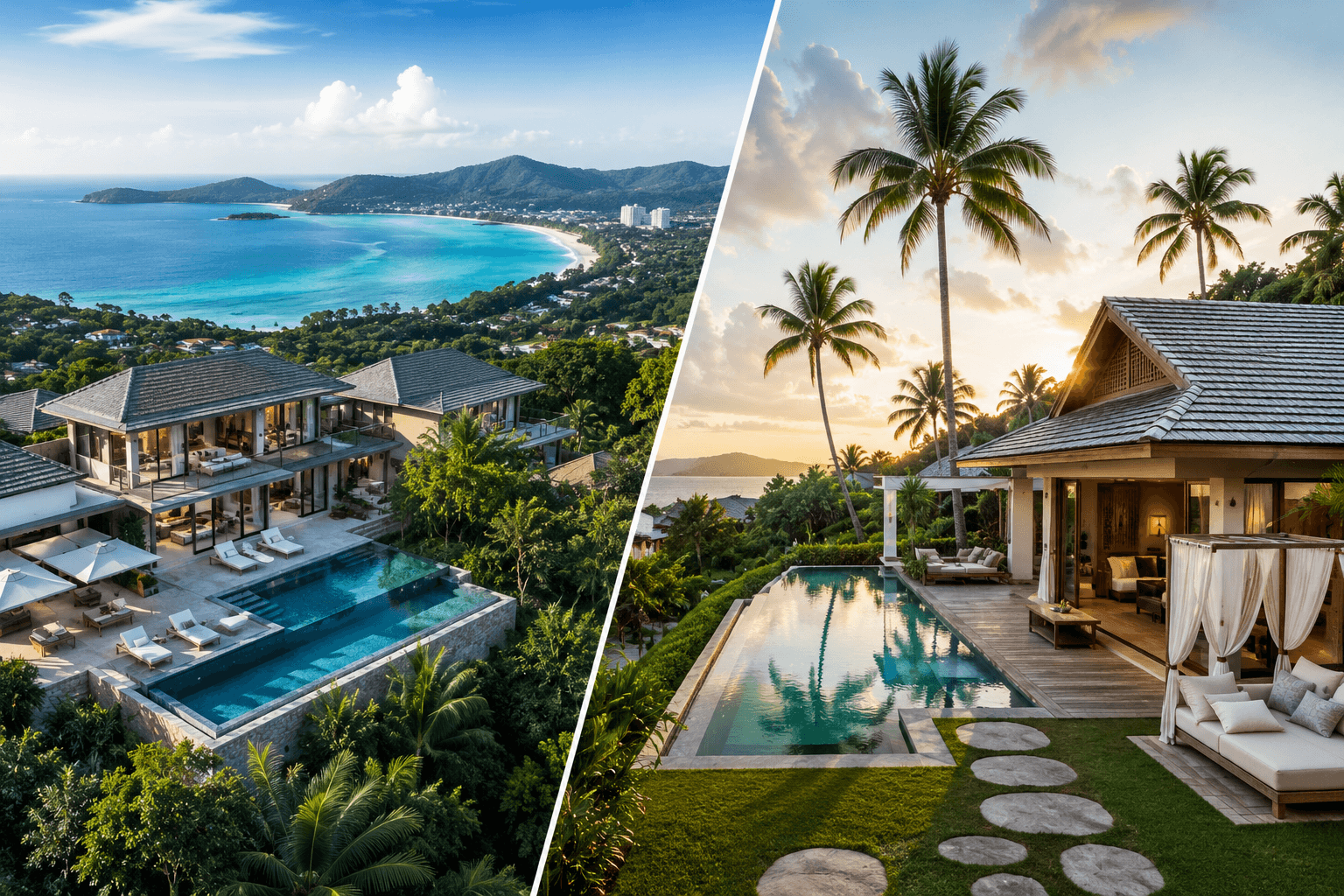
Investment vs Family Villas: Comparing Phuket and Koh Samui Neighborhoods
A neighborhood-by-neighborhood look at how Phuket and Koh Samui differ when you're buying for rental yield versus buying for your own family, and why the right choice depends on what you actually want from the property.
Investment vs Family Villas: Comparing Phuket and Koh Samui Neighborhoods
When foreign buyers start looking at villas in Phuket or Koh Samui, the first question is rarely "which island" — it's "what do I actually want this property to do for me." A villa bought purely for rental income behaves completely differently from a villa bought as a family base, and the neighborhoods that make sense for one almost never make sense for the other. After years of working directly with sellers and developers across both islands, the pattern is consistent: investors who skip this distinction end up disappointed, regardless of which island they chose.
Phuket's investment zones: Bang Tao, Kamala, and the airport corridor
If short-term rental yield is the priority, Phuket gives you more depth of market than Koh Samui simply because of tourist volume. Bang Tao, anchored by the Laguna complex, has the highest density of branded residences and serviced villa operators on the island, which means buyers get access to established rental management infrastructure from day one. Occupancy here tends to stay strong even in shoulder season because the area pulls a mix of package tourists and longer-stay digital nomads who book through the same platforms.
Kamala sits slightly cheaper per square meter than Bang Tao while still commanding strong nightly rates, mostly because it has avoided the high-rise development that changed the character of Patong further south. For an investor focused purely on cash-on-cash return rather than capital appreciation, Kamala villas with three to four bedrooms tend to outperform larger properties, since group bookings (families, friend groups) drive the bulk of demand and don't need five-bedroom footprints.
The area near Phuket International Airport, including parts of Mai Khao and Nai Yang, is a newer story. Land here was historically undervalued because of noise and flight path concerns, but the airport's expansion plans and the area's beachfront still being relatively undeveloped have pushed several international developers to launch projects there in the last two years. This is higher risk — less rental track record — but for an investor willing to buy earlier in a cycle, the entry prices are meaningfully below Bang Tao.
Koh Samui's investment zones: Chaweng, Bophut, and Lamai
Koh Samui's rental market is smaller but arguably more resilient because it depends less on mass tourism and more on a returning base of long-stay visitors, particularly from Europe and increasingly from the Middle East. Chaweng remains the highest-volume rental zone on the island simply because of beach access and nightlife proximity, but it's also the most saturated, meaning new villa supply competes hard for bookings against established properties with years of reviews.
Bophut, anchored by Fisherman's Village, has become the preferred zone for investors targeting a slightly older, higher-spending guest profile — couples and small families rather than groups. Villas here rent for fewer nights per year than Chaweng on paper, but at meaningfully higher nightly rates, and the area's walkable dining scene gives it an appeal that doesn't depend purely on beach weather.
Lamai is the value play. It has beach access comparable to Chaweng at a land cost that's typically 20 to 30 percent lower, and while the rental demand is currently softer, it's the zone most often mentioned by long-term residents on the island as the next area to develop. For investors buying with a five-to-ten-year hold in mind rather than immediate yield, Lamai land and existing villas both look comparatively undervalued right now.
Where families should actually be looking instead
Family buyers — people planning to use the villa themselves for a meaningful part of the year, or eventually relocate full-time — should generally be looking at almost the opposite criteria from the investor list above. Proximity to international schools, hospital access, and a quieter daily environment matter more than nightly rate potential, and overlapping these priorities with the highest-yield rental zones usually produces disappointment on both fronts.
On Phuket, the Cherngtalay and Thalang areas sit close to the island's main international schools and to Bangkok Hospital Phuket, while still being a manageable drive from Bang Tao's restaurants and grocery infrastructure. These areas don't have Bang Tao's beachfront premium built into the price, which means family buyers often get considerably more land and living space for the same budget. The trade-off is needing a car for daily life, which most relocating families plan for anyway.
On Koh Samui, families tend to settle around Maenam or the inland areas near Bo Phut rather than directly on Chaweng beach. Maenam in particular has a noticeably different rhythm — quieter, more residential, with a growing expat community that has built up its own informal network of schools, clinics, and recommendations. Samui International School and the island's main hospital are both reasonably central from this part of the island, which matters more once you're living there year-round rather than visiting for two weeks.
A note on ownership structure across these areas
One detail that catches first-time buyers off guard, regardless of which neighborhood they choose, is that "owning" a villa in Thailand rarely means owning the land beneath it in the way buyers expect coming from Europe or the Gulf. Foreigners cannot directly own freehold land in Thailand, which means villa purchases in almost every area mentioned above are structured either as a long-term leasehold (typically 30 years with renewal options) or through a Thai limited company that holds the land, with the foreign buyer holding shares in that company. Both structures are completely legal and widely used, but they behave differently depending on the area: leasehold renewal terms in long-established zones like Bang Tao or Chaweng tend to be more standardized and easier to verify against precedent, while company-structure purchases in newer development zones near the Phuket airport corridor or in parts of Lamai require more careful due diligence simply because there's less of a track record to compare against. This is one of the areas where buying through a single team that handles the legal structure, the company formation, and the actual property search together — rather than coordinating a lawyer, an agent, and a company-formation service separately — tends to prevent the gaps where problems usually surface.
The mistake we see most often
The most common error among buyers we work with directly is choosing a location based on holiday memories rather than the property's actual purpose. A couple who loved a week in Chaweng will often want to buy there, even when their stated goal is a quiet family retirement home — and the reverse happens just as often, where an investor falls for a peaceful Lamai or Maenam property and then can't understand why occupancy doesn't match Chaweng-level bookings. Matching the neighborhood to the actual use case, before falling in love with a specific villa, is the single biggest factor in whether a Phuket or Koh Samui purchase performs the way the buyer expected.
This is also where the islands genuinely differ from each other rather than just from neighborhood to neighborhood. For a deeper side-by-side on which island fits which type of buyer overall, our comparison of Phuket and Koh Samui covers the broader picture, and for buyers focused specifically on Koh Samui's rental numbers by area, our breakdown of the island's best-performing zones goes into more pricing and ROI detail .
What this means for your search
If you're buying primarily for yield, narrow your search to Bang Tao, Kamala, Chaweng, or Bophut, and treat anything quieter as a longer-term, higher-risk bet rather than your primary target. If you're buying primarily to live, start your search in Cherngtalay, Thalang, or Maenam, and resist the pull of beachfront listings that look perfect for two weeks a year but would wear thin as a daily reality. And if you're trying to do both — generate income now with a plan to move in permanently later — be honest that this is the hardest combination to get right, and that it usually means accepting a slightly lower yield in exchange for a location you could actually live in without regret.
We work with buyers on both islands across this exact spectrum, from pure rental plays to full family relocations, and the villa inventory we see directly in the field changes faster than most listing sites reflect. If you already have a budget and a rough sense of which side of this — investment or family base — matters more to you, that's the right starting point for a focused shortlist rather than browsing every listing on both islands at once.
Next step
Ready to turn insight into action?
Book a free, no-obligation consultation with Benjamin and get a curated shortlist of off-plan opportunities matched to your goals.
Book a Consultation TodayBenjamin Nagy
Off-plan property investment advisor